
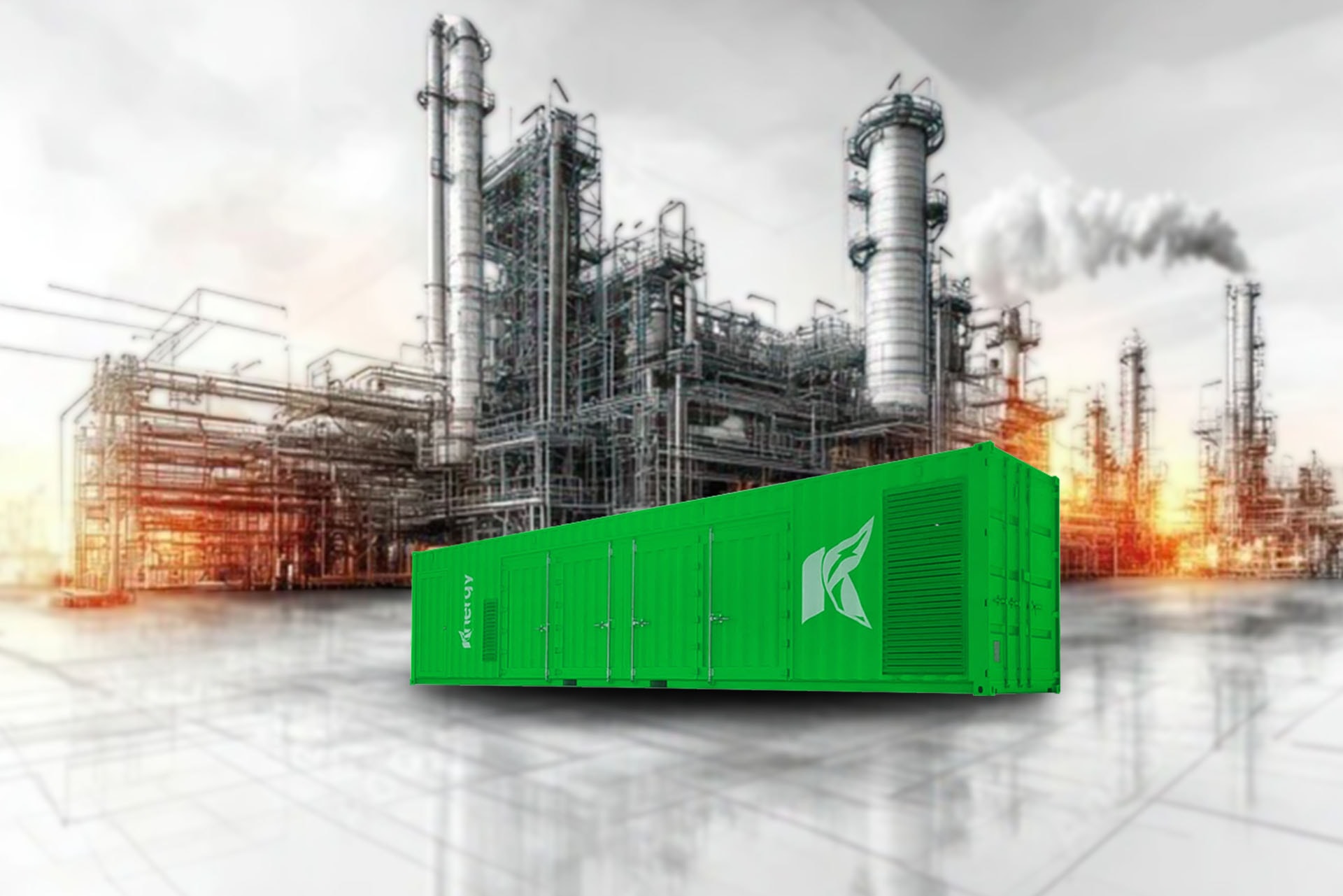
Hydrogen in steelmaking: from the reheating furnace to green DRI.
The steel industry — coke plants, blast furnaces, electric arc furnaces, heat treatment lines, reheating furnaces — shares a structural challenge with cement: high-temperature processes that are hard to electrify, heavy dependence on fossil fuels, and growing regulatory pressure on emissions.
Two complementary technological routes
Knergy offers two complementary technological routes for this industry: combustion catalysis with H₂/O₂ in existing processes (immediate application) and scale green hydrogen solutions for direct reduction processes (DRI-H₂).
Immediate application in steel furnaces
Combustion catalysis in reheating furnaces and heat treatments: immediate application, profitable, with no plant shutdown.
Billet reheating furnaces
H₂ injection to stabilize the flame, reduce specific natural-gas consumption, and improve the product's thermal uniformity.
Heat treatment furnaces
Hardening, tempering, annealing, normalizing — with greater atmosphere control and lower energy consumption.
Ladle and cupola furnaces
Improved combustion kinetics and reduced NOx emissions.
Coking furnaces
Thermal optimization with controlled catalysis.
Auxiliary heating systems in blast furnaces
Partial substitution of natural gas with green H₂.
Five fronts of simultaneous improvement
↓ Natural gas consumption
5%–15% reduction in specific thermal consumption.
↑ Furnace productivity
Better heat transfer and more complete combustion.
↓ NOx and CO₂ emissions
Lower flame temperature controlled with O₂ and less fossil fuel use.
↑ Product quality
Greater thermal uniformity and less surface decarburization.
No plant shutdown
Installation during scheduled maintenance, non-invasive integration into the control system.
The deep decarbonization route for primary steelmaking
Direct reduction of iron ore with green hydrogen is the most promising technological route for the deep decarbonization of primary steelmaking. It replaces natural gas and/or metallurgical coke — traditionally used as reducing agents — with green hydrogen.
Reaction and environmental benefit
Fe₂O₃ + 3H₂ → 2Fe + 3H₂O
The byproduct is water, not CO₂. A DRI-H₂ plant at full capacity can eliminate up to 95% of direct Scope 1 emissions compared to a traditional blast furnace, depending on route and energy mix.
MW-scale green hydrogen plants
Design and integration of multi-MW plants (5–50 MW per project) coupled to the DRI plant.
Integration with renewables
Hybrid solar + wind + storage + electrolysis systems to guarantee stable H₂ supply.
Progressive substitution
Solutions for H₂ + natural gas blends in existing Midrex/Energiron plants, with gradual scaling toward 100% H₂.
Process engineering
CFD modeling, thermal optimization, integration into the plant DCS — the same methodology applied in cement.
Where we apply in steelmaking
- Reheating furnaces (billet, slab, sections)
- H₂/O₂ catalysis — immediate application
- Heat treatment furnaces (hardening, annealing)
- Catalysis + atmosphere control
- Coking furnaces
- Thermal optimization with H₂
- Midrex / Energiron DRI plants
- Progressive substitution of natural gas with H₂
- Blast furnaces (BF)
- Tuyere injection as a complement to PCI
- Electric arc furnaces (EAF)
- Optimization of auxiliary oxy-fuel burners
- Ladle and melting furnaces
- Improved kinetics and emissions control
Cement experience transferred to steel
Cross-cutting experience
The principles of high-temperature combustion, CFD modeling, functional safety systems and 24/7 operation are transferable from cement to steel.
Proven technical capability
Pyroprocess engineering, rotary kiln optimization and large-scale combustion systems.
Dual portfolio
We can address both immediate-application solutions (combustion catalysis) and deep decarbonization projects (DRI-H₂).
Receive the techno-economic assessment of your steel mill
Individual analysis of your furnaces and reduction processes. We do not send catalog quotes.